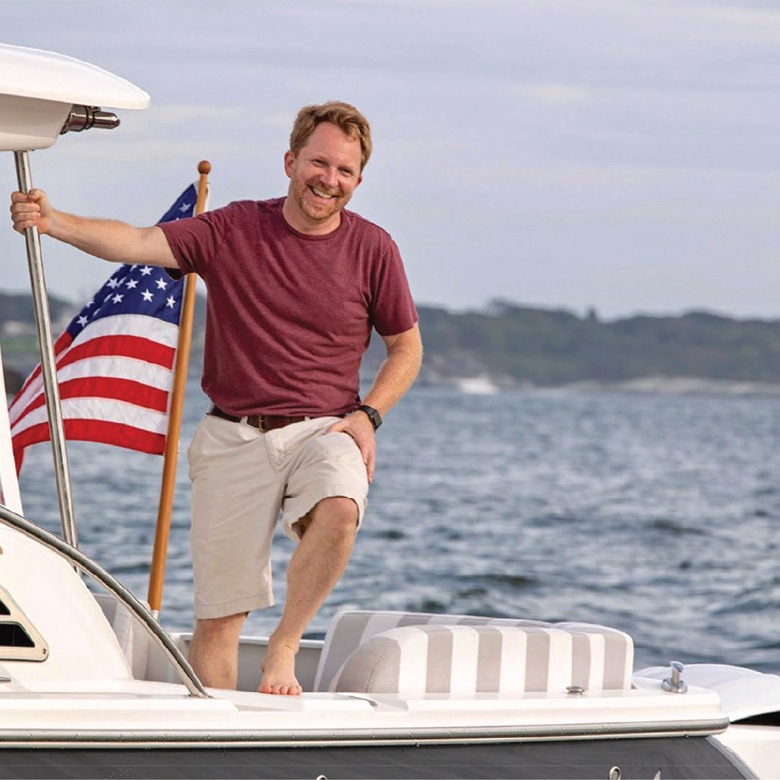
Built For People Who Live By The Tides

Find tide charts and weather for 1,400 harbors across the U.S.

US Harbors is the #1 Source for Tide Charts and Coastal Information for over 1,400 harbors in 30 coastal states. Our curated data helps you plan smarter, enjoy your time on the water, and stay ahead of rapidly changing tides, storms, and flooding.
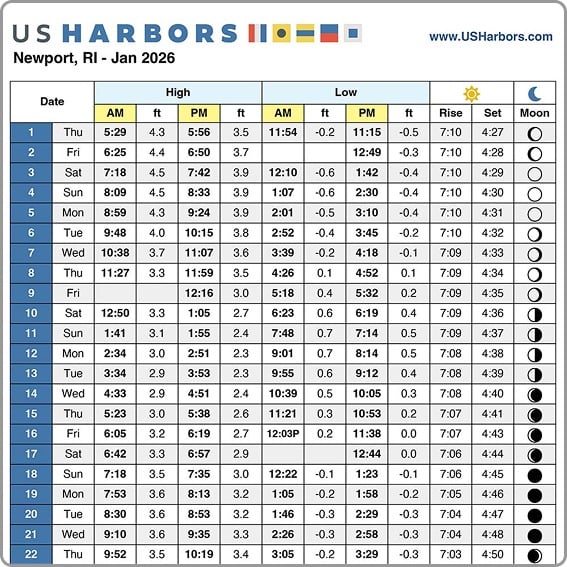
Tide Charts

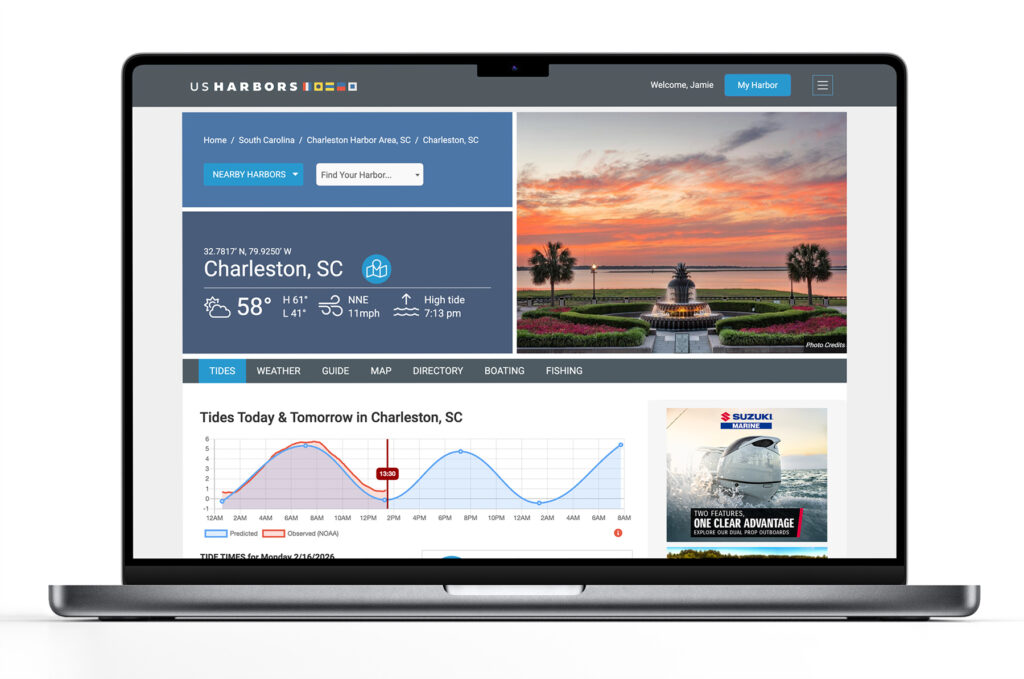
US Harbors illustrates tide forecasts with our simple, intuitive charts. Easily scan the highs and lows online or print a convenient monthly tide chart for the boat or office.
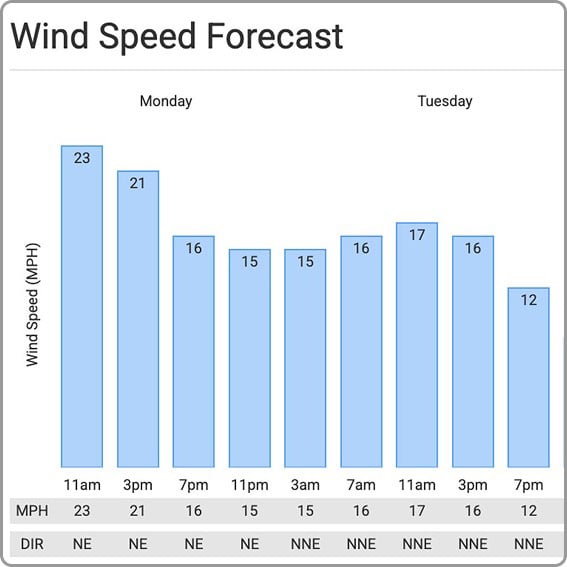
Wind speed forecast bar graph

Weather

US Harbors delivers weather predictions with a focus on marine forecasts, buoy data, weather alerts, and onshore forecasts for harbors near you that include wind speed and direction, relative humidity, and more.
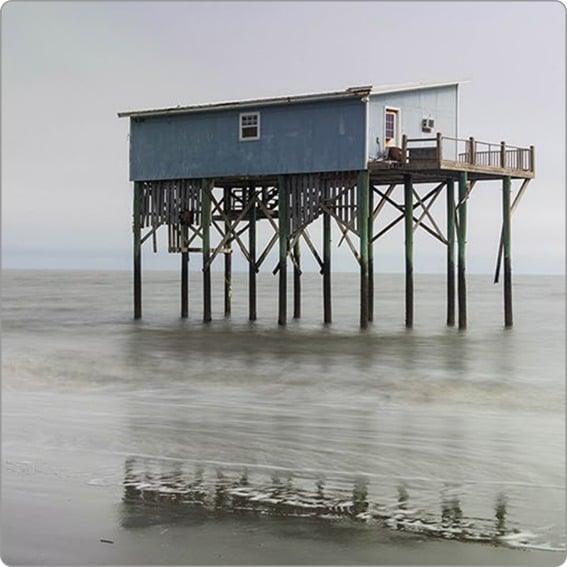
High Tide Flooding

Each month, we publish a high-tide flooding report for forecasted harbors across the country. Look for harbors near you to know when extreme high tides could cause flooding. Sign up for our newsletter to be alerted to new high tide flooding reports.
"I rely on US Harbors and consult it many times a week during boating season and often multiple times per day. I've also recommended it to other boaters as a truly valuable resource."

- Bill P. Long Island, NY

Latest Coastal News Filter

Measuring a 'dead zone': Scientists retrieve the CTD (conductivity, temperature, depth) package of ocean sensors after profiling dissolved oxygen at a station during the Shelfwide Hypoxia Cruise in the Gulf of America. (Image credit: Courtesy of Cassandra Glaspie/LSU)

NOAA and Partners Find Smaller-than-Anticipated Hypoxic Zone in Gulf of America

8/25/2026

By fisheries.noaa.gov, fisheries.noaa.gov. NOAA-supported scientists announced today that this year’s Gulf of America hypoxic zone is approximately 1,332 square miles, making it the 2nd smallest zone on record in 40 years of measurement. Hypoxic areas, also called “dead zones,” are areas with little to no oxygen in the water, which… SEE MORE

Image Credits: fisheries.noaa.gov.

New Satellite Tag Offers Longer Tracking of Baleen Whales

8/24/2026

By fisheries.noaa.gov, fisheries.noaa.gov. How do you track a 40-ton ocean giant without leaving a mark? Monitoring large whales is a delicate balancing act between science and safety. Satellite tags allow researchers to follow the movements of whales beyond where they can be seen. This helps us understand how whales overlap with human… SEE MORE

Image Credits: fisheries.noaa.gov.

Technology Week: Launching into the Future with Advanced Technologies

8/21/2026

By fisheries.noaa.gov, fisheries.noaa.gov. NOAA scientists rely on cutting-edge technology to collect and analyze the data needed to manage our ocean resources and habitats. Because some ocean creatures live in remote areas and have complex life cycles, better understanding them requires unique tools. By leveraging advanced technologies, we gather critical data to… SEE MORE

Rhyl Frith prepares to catch the FreeFly Astro research drone on the R/V Nancy Foster while tagging whales. Taken under NOAA permit # 27066. Credit: Julia Zeh

Giving North Atlantic Right Whales a Check-Up Using Advanced Technology

8/20/2026

By fisheries.noaa.gov, fisheries.noaa.gov. This story is part three of a three-part series. Read about how we are listening for North Atlantic right whales with passive acoustics, monitoring them with aerial surveys, and using boats, drones, uncrewed surface vehicles and satellites to learn as much as we can about them and their habitat.… SEE MORE

Image Credits: Fisheries.noaa.gov.

The Unexpected Catch: Friendship at Sea

8/19/2026

By fisheries.noaa.gov, fisheries.noaa.gov. One Random Room Assignment When I graduated from college and entered the workforce, I never imagined my path would lead me to becoming a fisheries observer. It wasn’t exactly a career I had planned, but looking back, I’m so glad it found me. Before the month-long training began,… SEE MORE

Members of the monitoring show off adult salmon captured at a monitoring station. From left to right, Kevin Vandenack holds a steelhead, Katherine Stonecypher holds a coho salmon, and Bryan Crouch holds a Chinook salmon. Credit: Katherine Stonecypher/Cal Poly Humboldt

Can Habitat Restoration Help Salmon Recover? Prairie Creek Offers Clues

8/18/2026

By fisheries.noaa.gov, fisheries.noaa.gov. This story is part 2 of a 2-part series. Read part 1. When any habitat restoration project finishes, a critical question remains: Will the project help threatened fish and other species recover? Answering that question requires rigorous long-term monitoring. At the Prairie Creek salmon habitat restoration project in Northern California,… SEE MORE

Prairie Creek project partners gather at the restoration site before construction begins. Credit: Michael Weir/CalTrout

Restoring California’s Prairie Creek Supports Salmon Recovery and Local Community

8/17/2026

By fisheries.noaa.gov, fisheries.noaa.gov. This story is part 1 of a 2-part series. Read part 1. For more than a decade, NOAA Fisheries and a broad coalition of partners worked to transform degraded fish habitat on California’s Prairie Creek into a thriving floodplain ecosystem for juvenile salmon and steelhead. Located in California’s redwood… SEE MORE

A researcher in a U.S. Coast Guard helicopter first spotted the entangled humpback anchored to the bottom about 20 miles off the Oregon Coast. The whale’s white pectoral flipper extends underwater to the lower left, while white baleen outlines its open lower jaw at bottom right. The entanglement left the whale’s mouth stretched permanently open, making it unable to feed. Photo collected in partnership with Oregon Coast Aquarium, Oregon State University Marine Mammal Institute and Cascadia Research Collective.

Fishing Vessel Joins Trained Team to Free Injured Humpback Whale 20 Miles off Oregon Coast

8/16/2026

By fisheries.noaa.gov, fisheries.noaa.gov. An Oregon team joined by experts from Washington and a local fisherman freed a severely entangled humpback whale about 20 miles off the Oregon Coast on July 26. While the team removed all of the gear from the whale, the entanglement left the young whale’s jaw permanently… SEE MORE

Unlock The Best of US Harbors

Sign up for our monthly newsletter with the monthly flooding report, save your favorite harbor to your profile, and join our coastal community.

Sign Up for Our Newsletter

A laptop computer displaying the tide page on US Harbors

Who Is US Harbors?

We are a community of boaters, fishermen, surfers, scientists, waterfront homeowners, along with mariners and coastal professionals who work and live by the water. It is the project of a committed team who understand how conditions influence work and play on the coast because we live by the tides just like you. Our home port is Camden, Maine, one of over 1,400 harbors we serve.

Camden, Maine is my home harbor

"As someone who has always loved the ocean, I created US Harbors to be a resource that helps everyone in any harbor get the most from their coastal experience, boating, fishing, surfing, and living by the tides."

Founder, Jamie Bloomquist
Jamie Bloomquist, US Harbors owner